
 Free Delivery & Return
 365-Day Returns
 10 Million Happy Customers
 500,000 Products in Stock


Outdoor Lighting


Outdoor Lighting
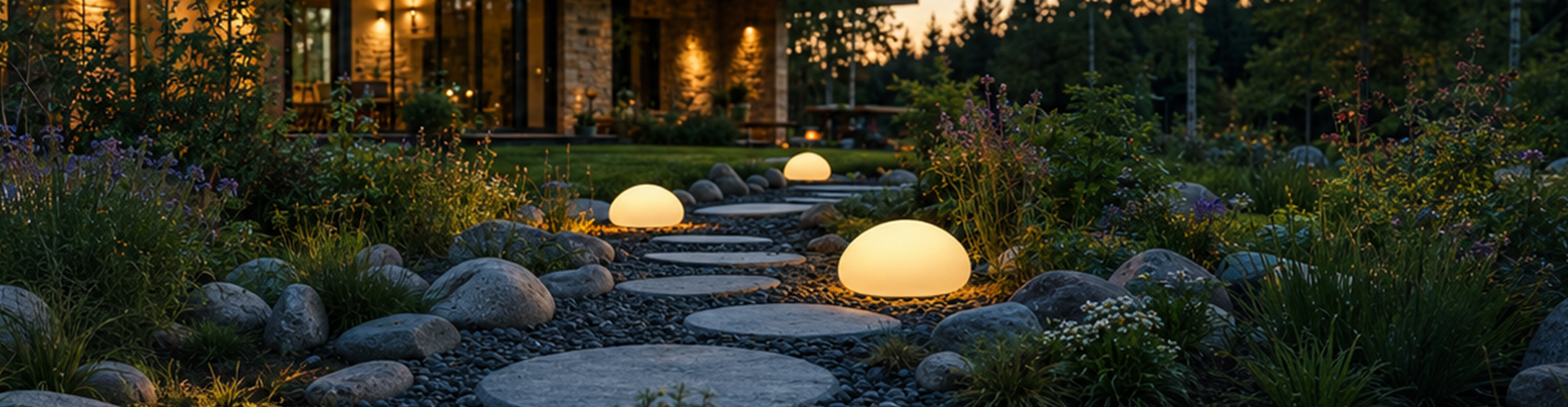
Outdoor lighting decides how usable a garden, terrace or balcony is once it gets dark, and how safe it feels to cross on a wet evening. The choice involves far more than the look of the fitting: weather protection, brightness, colour temperature and power supply all determine whether a light still does its job in its third winter outside. This page explains which type of light suits each area around a home, and what the specifications on the product page actually mean.
How to plan lighting for a garden, terrace or balcony?
Outdoor lighting works better as several modest light sources than as one bright one. A single floodlight over a terrace flattens the space, creates hard shadows and leaves the rest of the garden looking darker than it really is.
Start by walking the route you actually take after dark and noting where you need to see: the gate, the step up to the door, the keyhole, the bin store, the point where the paving changes level. Those are the places that need functional light. Everything else is atmosphere, and can be much dimmer.
Which type of outdoor light suits each area?
Each type of outdoor light is built for a particular job and a particular mounting position, so the fastest way to narrow the choice is to decide what the light has to do before looking at styles.
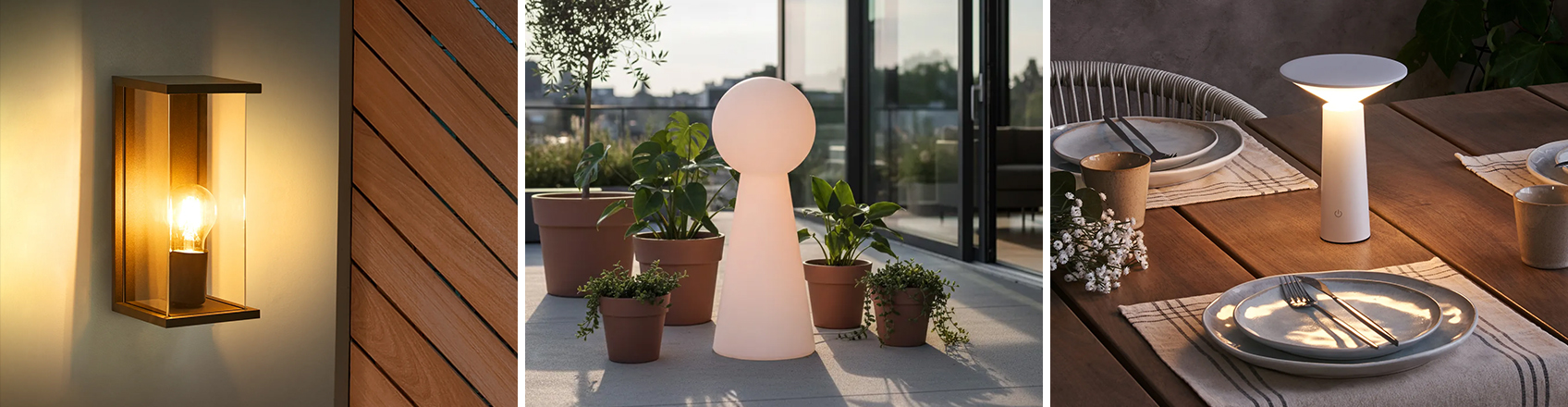
Wall lamps
Best for
Front doors, terraces, garage walls and house façades
Placement
Beside a door with the centre of the fitting roughly 1.6 to 1.7 m above the ground, which puts the light near eye level
Good to know
Up-and-down models wash the wall and keep the light source out of your line of sight
Lamp posts
Best for
Driveways, front gardens and longer approaches to a house
Placement
Along the edge of a drive or path, where a taller light source can cover a wide area from one point
Good to know
Usually needs a fixed base and a buried cable, so the position has to be settled before paving or planting
Bollard lamps
Best for
Garden paths, borders, steps and the edges of a terrace
Placement
About 1.8 to 2.4 m apart, staggered from side to side rather than set out in facing pairs
Good to know
A shielded top directs light down onto the path and prevents glare at walking height
Floor lamps
Best for
Covered terraces, porches, balconies and outdoor lounge corners
Placement
Beside seating, where the base sits clear of the route people walk
Good to know
Rechargeable versions can be carried between the terrace and the house and need no wiring
Table lamps
Best for
Dining tables, side tables, window sills and balcony railings
Placement
On the table itself, low enough to light the surface without shining into people's eyes
Good to know
Check the stated run time per charge and whether brightness can be reduced, as lower settings last longer
Decorative lamps
Best for
Atmosphere around seating, steps, planting and garden features
Placement
Grouped at different heights in a few places rather than spread evenly across the garden
Good to know
Decorative light is not a replacement for functional light at an entrance or on steps
Shop now: outdoor wall lamps and bollard lamps
How weatherproof does an outdoor light need to be?
Weather protection is expressed as an IP rating, defined by the international standard IEC 60529 and published in Europe as EN 60529. The first digit describes protection against solid objects and dust, the second against water. For outdoor lighting, the second digit is the one that decides whether a fitting survives.
Match the rating to the exact spot, not to the garden as a whole. A lantern under a deep porch and a spike light sitting in a flowerbed face completely different conditions. Read the scale below from the most sheltered position to the most exposed: the more water a fitting meets, the higher the second digit needs to be.
IP44
Sheltered
Protects against
Solid objects from 1 mm upwards and water splashing from any direction
Use it for
Covered balconies, porches, carports and other positions sheltered from direct rain
IP54
Semi-sheltered
Protects against
Dust in harmful quantities and water splashing from any direction
Use it for
Walls under an overhang, semi-sheltered terraces and dusty positions near a drive
IP65
Fully exposed
Protects against
Dust completely, and water jets directed at the fitting from any direction
Use it for
Fully exposed walls, open paths, driveways and anywhere wind drives the rain sideways
IP67
Ground level and water
Protects against
Dust completely, and temporary immersion in water up to 1 m deep for 30 minutes
Use it for
Ground-level and recessed fittings, lights beside ponds and spots where water pools after rain
IP67 is not the same as waterproof for good
IP67 covers temporary immersion only. A fitting that is meant to sit permanently under water, such as a pond or fountain light, needs IP68 and is almost always low voltage.
Which materials cope best outdoors
The housing decides how the light ages. Rain is rarely the problem on its own; it is the combination of damp, frost, UV and, near the coast, salt.
- Powder-coated aluminium: light, will not rust and holds colour well, so it suits wall and bollard lights. Touch up chips in the coating before they spread.
- Stainless steel: check the grade. A2 (304) is fine inland, while A4 (316) resists salt far better and is the safer choice within a few kilometres of the sea.
- UV-stabilised plastics and polyresin: used for solar and decorative lights because they stay light and never corrode, though colours can fade over several seasons.
- Glass and polycarbonate diffusers: glass stays clear longer, while polycarbonate is harder to break and better suited to ground-level fittings and play areas.
- Wood and rattan effect: attractive on covered terraces and balconies, but it benefits from being stored under cover over winter.
Mains, low voltage, solar or battery: which power source fits?
The power source governs where a light can go, how bright it can be and how much work the installation takes. It is worth settling before choosing a style, because it rules out whole categories of product.
Mains
Best for
Permanent lighting at entrances, driveways and main paths
Installation
Fixed wiring. New outdoor electrical work must be done or certified by a qualified electrician, and rules differ by country
Good to know
Brightness never depends on the weather, which is why safety-critical lighting is usually mains-powered
Low voltage
Best for
Spike, path and border lighting added to a garden that is already finished
Installation
A transformer in a dry or weatherproof position feeds a 12 V cable that runs along the border or just under the surface
Good to know
Easy to extend later, but national wiring rules can still apply, so check the requirements in your country before burying cable
Solar
Best for
Borders, paths and balconies with no power supply nearby
Installation
No wiring at all, but the panel needs a position in direct daylight, clear of shade from walls, fences and evergreen planting
Good to know
Output falls in winter when days are short and the sun is low, so solar suits decorative rather than safety-critical lighting
Rechargeable
Best for
Table and floor lamps that move between the terrace, the balcony and indoors
Installation
None. The lamp charges indoors, usually over USB, and is carried out when needed
Good to know
The most practical option for rented homes and balconies where drilling or fixed wiring is not allowed
How bright should outdoor lighting be?
Brightness is measured in lumens, not watts, and outdoor spaces need far less of it than most people expect. Eyes adapt to darkness, so a light that looks modest indoors is often ample on a path.
- Step lights: roughly 12 to 100 lumens
- Path and bollard lights: roughly 100 to 200 lumens
- Wall lights for a terrace or entrance: around 400 to 600 lumens for comfortable general light
- Motion-activated lights: roughly 300 to 700 lumens
- Floodlights for a driveway or working area: roughly 700 to 1300 lumens, the one case where a higher output is justified
For general garden lighting, staying below 1000 lumens per fitting is kinder to wildlife and to your neighbours. Only floodlights for a driveway or working area need to go higher, and they work best on a motion sensor or timer. Several low-output lights almost always look better than one bright one, and they leave fewer dark patches between pools of light.
Warm white or neutral white?
Colour temperature is given in kelvins. Warm white at 2700 K is the most comfortable choice around seating, dining areas and planting, because it flatters natural materials and keeps the mood relaxed. Neutral white at 3000 K to 4000 K reads as clearer and more alert, which helps at a front door, on steps and along a driveway.
Keep the whole scheme within a narrow range. Mixing 2700 K and 5000 K fittings in one line of sight makes the warmer lights look dull and yellow by comparison.
Keep the light on your own plot
Dark-sky guidance for outdoor fittings recommends a maximum of 3000 K, with 2700 K or lower preferred, combined with shielded fittings that aim light downwards. Warm, amber-toned light also attracts fewer flying insects than blue-rich white light, which makes it the better choice near a dining table or an open window.
Read more: lighting ideas to set the mood in any space
Where to position outdoor lights
Position does more for the result than the brightness of any single fitting. The aim is to light surfaces that people need to see, while keeping the light source itself out of their line of sight.
- Mount wall lights beside a door with the centre of the fitting about 1.6 to 1.7 m above the ground, so the light falls at face height
- Space path and bollard lights about 1.8 to 2.4 m apart and stagger them along the route, which avoids the runway effect of facing pairs
- Light every change of level separately, since a single step is the easiest thing to miss in the dark
- Aim uplights at a trunk, wall or hedge rather than across a seating area, and tilt them as close to vertical as the subject allows
- Keep fittings back from the edges of a terrace so that glare does not reach a neighbour's window
- Check a solar panel position in midwinter rather than midsummer, because the sun sits far lower and shade from buildings reaches much further
Shop now: outdoor decorative lamps
How should outdoor lights be switched?
Switching is the part most people decide last and regret first. A light that has to be turned on from inside the house usually ends up either permanently on or never used.
- Motion sensors (PIR) suit entrances, side passages and bin stores, where light is only needed for a minute or two. Check whether sensitivity and duration can be adjusted.
- Dusk-to-dawn photocells suit a single welcoming light that should come on by itself each evening without any input.
- Timers suit decorative and path lighting, and stop the garden staying lit after everyone has gone to bed.
- App or smart control is useful when several zones are dimmed or scheduled together, but it depends on a stable signal reaching the far end of the garden.
- Portable rechargeable lamps need no switching plan at all, which is part of their appeal on a balcony.
What to check before buying
Work through these points against the specific spot where the light will go.
- The IP rating against the exact position: IP44 under cover, IP65 in the open, IP67 at ground level or near water
- The power source against what is actually available there: mains, low voltage, solar or rechargeable
- Lumen output against the job the light has to do, rather than the highest figure on the page
- Colour temperature in kelvins, kept consistent across every fitting visible at once
- Whether the LED is integrated or the bulb replaceable, and which socket type a replaceable bulb uses
- Material and finish against your climate, with A4 stainless steel or powder-coated aluminium near the coast
- Fitting dimensions and fixings against the wall, post or path width, plus cable length and plug type for plug-in models
Frequently asked questions
Can outdoor lights be left outside all winter?
Yes, as long as the IP rating matches the position and the fitting is sold for permanent outdoor use. Damage in winter usually comes from water that has worked its way inside a fitting and then frozen, so check that seals and covers are intact and that drainage holes are not blocked before the cold sets in. Portable rechargeable lamps are the exception and last longer if they are brought indoors.
Can the bulb be replaced in an integrated LED outdoor light?
No. In an integrated LED fitting the light source is built into the body, so the whole fitting is replaced once the LEDs reach the end of their life. If you prefer to change bulbs yourself, choose a model with a standard socket such as E27 or GU10 and check which bulb type the manufacturer allows.
Which lights can be used near a pond or water feature?
Fittings near the water's edge that may get sprayed or hit by jets need at least IP65, those that may end up briefly underwater need IP67, and anything designed to stay submerged needs IP68. Lighting in or beside water is normally low voltage for safety reasons. Have it installed by a qualified electrician, as the rules for wiring near water are stricter than for the rest of the garden.
How much does outdoor lighting cost to run?
LED fittings use very little power, and you can work out your own figure from the wattage printed on the product. A 10-watt fitting used for five hours a night uses about 1.5 kWh a month. Motion sensors and timers cut this further, because most outdoor lights do not need to be on all evening.